The top priority for Adobe’s next CEO? Prepping for the ‘age of agents’
Adobe’s Shantanu Narayen announced plans to step down as CEO last month after 18 years leading software vendor through several periods of tech change from the arrival of the cloud, mobile computing, and the early days of artificial intelligence.
For whomever is tapped next for the top job — the search is expected to take several months — the biggest priority will be reshaping Adobe’s products and strategy for the next wave of agentic AI, analysts said.
“Ultimately, Adobe must evolve from a leader in creative tools to the system that connects content, context, and commerce in a world of real-time agentic interactions,” said Gerry Murray, research director at IDC.
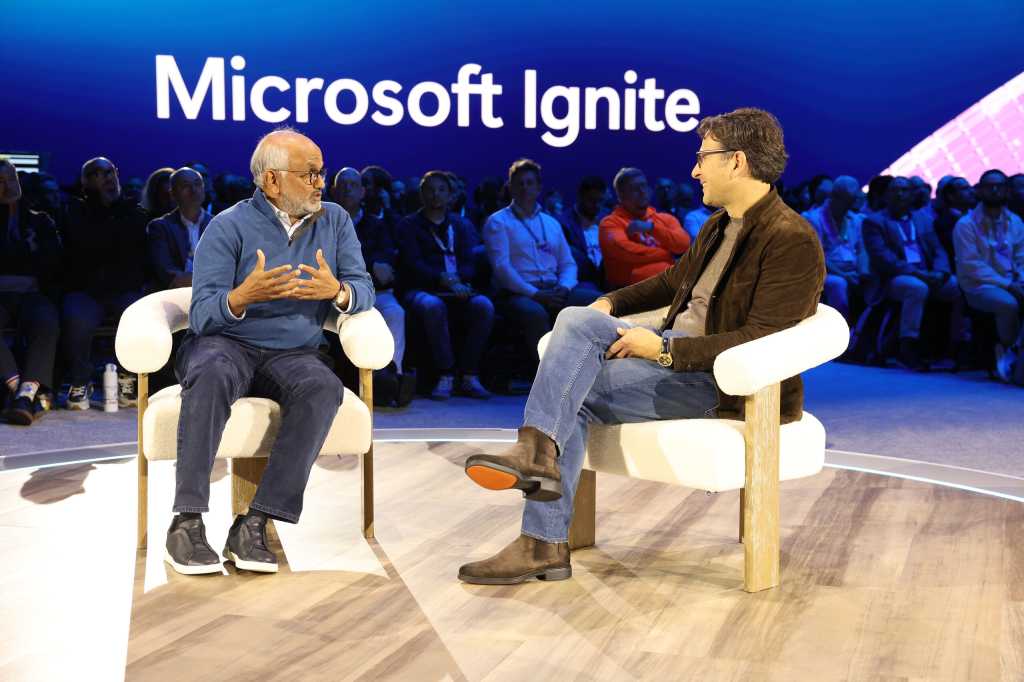
Adobe CEO Shantanu Narayen (L) and Judson Althoff, CEO of Microsoft’s commercial business, speak on stage at Microsoft Ignite 2025.
Microsoft
Narayen’s resignation, will “force the Adobe board to search for a leader who is not just a master of the subscription economy, but a visionary in the ‘agentic’ AI era,” Jim Lundy at Aragon Research said in a blog post last month.
The coming change at the CEO level will also lead to a renewed focus from financial markets on whether Adobe can “maintain its dominant margins without Narayen’s steady hand at the helm,” said Lundy.
Questions about the company’s path ahead come as it prepares for Adobe Connect later this month in Las Vegas. The event runs April 20-22.
Adobe was among the early adopters of generative AI (genAI) with the launch of its Firefly model in March 2023, positioning itself as a commercially safe tool for enterprise customers such as IBM, Pepsi and Mattel to generate content. It later expanded Firefly with the addition of multi-modal AI tools that included video, vector and audio, while embedding Firefly across its software and rolling out GenStudio in 2024 to help businesses manage AI-generated at scale.
Those moves have yet to reassure investors that the company is on solid footing. Adobe’s stock fell following its latest earnings report, despite seeing better-than-expected revenue and a three-fold year-on-year increase in AI-related sales.
The company faces competition from a number of vendors, including Canva and Figma, which also offer creative design tools. It is also must contend with AI providers such as OpenAI and Google that enable users to generate content via prompts.
Although he will remain as chairman of the board, Narayen’s departure adds to the uncertainty around Adobe’s future.
“While Adobe is currently in a position of strength,” said Lundy, “a leadership change of this magnitude often invites aggressive competitive maneuvers from rivals in the marketing and design tech stacks.”
The key challenge for any successor will be “balancing Adobe’s professional-grade heritage with the increasing commoditization of creative tools driven by AI,” he said.
The most immediate pressure point for Adobe is its Creative Cloud suite, according to Murray, as competitors threaten Adobe’s dominance in the market. Adobe had 850 million monthly users across Acrobat, Creative Cloud, Express and Firefly, according to its most recent financial results.
“AI-native tools are collapsing the value of skill, time, and complexity, especially for students and prosumers,” he said. “Adobe will need to rethink pricing and packaging around outputs rather than tools, while dramatically simplifying the user experience.”
Another priority will be the need to differentiate its offerings from competitors that rely on similar AI models. This shifts competition away from engineering and towards a go-to-market strategy, Murray said, requiring Adobe to “innovate on pricing, packaging, and partners” to attract and retain users.
There’s also the prospect that increasingly capable autonomous third-party AI agents could put pressure on Adobe’s margins. While some SaaS-pocalypse concerns are overblown — including the prospect that business customers will vibe-code their own enterprise apps – the emergence of increasingly capable AI agents could push software applications down to an infrastructure layer that agents access on behalf of humans.
“AI is making it possible to recompose software dynamically, which threatens traditional application-layer value,” said Murray.
At the same time, he noted that Adobe also has the opportunity to “redefine its moat” around agentic workflows and its “unique ‘contextual fabric’ that connects content, data, and metadata to power intelligent automation.”
To help Adobe adapt to these ongoing technological shifts, the next CEO will need to appoint a “central authority to align AI product strategy, platform architecture, and partnerships across business units” or lead the charge.
Adobe requires a “robust AI stack,” he said, but will have to find its place in a shifting landscape.
“… Adobe is unlikely to own the enterprise AI control plane, so success will depend on building an open, interoperable stack that integrates with hyperscalers while delivering differentiated value at the application and workflow level,” said Murray.
Read more: The top priority for Adobe’s next CEO? Prepping for the ‘age of agents’